Craft & Material Research · Study 04In Progress
Tension as Feedback
Can differences in textile tension communicate a small set of system states without text, color, or a display?
July 2026 · Independent Material Research · Methods: mechanical prototyping, force-profile decomposition, comparative analysis · Materials: cotton and polyester cord, leather, felt, elastic cord, springs, wood or acrylic, textile stops

Cord under tension across a woven ground — fiber twist, contact points, and the taut line this study measures.
Overview
What if state were something the hand encountered?
A screen communicates state by changing pixels. A physical mechanism communicates through force: a lock stops, a detent marks position, and a spring resists displacement before returning to rest.
Fiber offers a softer mechanical language. A cord can be slack, preloaded, progressive, elastic, or fixed. Those conditions change how an action begins, how effort accumulates, and how an endpoint feels.
This study asks:
Can differences in textile tension communicate a small set of system states without text, color, or a display?
Tension is central to macramé. It controls spacing, symmetry, knot firmness, and field stability. Here it moves from fabrication variable to interface output.
Three Tactile States
Identical tabs, different mechanics
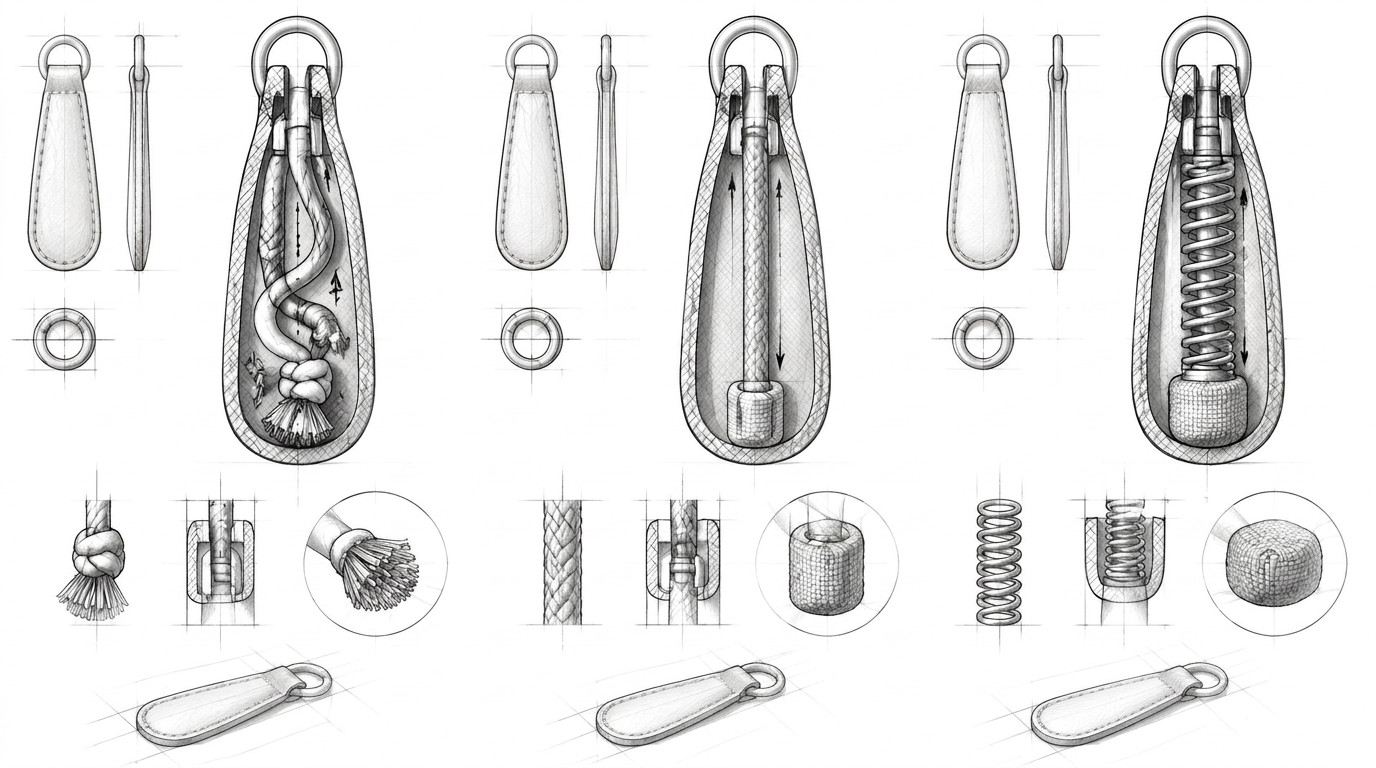
Three visually identical pull tabs sit in a leather panel. Interchangeable modules behind it create different force profiles.
Slack / unavailable
The first tab moves through a short region with minimal resistance and reaches a soft, unresolved end. It represents unavailable or disconnected. This mapping is intentionally critical: low resistance can also feel broken or unfinished. The sample tests whether slack can communicate a state or should be rejected as too ambiguous.
Progressive / adjustable
The second begins with light preload, increases resistance gradually, and returns smoothly. It represents continuous adjustment. Elastic cord or a small extension spring provides force, while knotted anchors set preload and travel.
Firm stop / confirmed
The third has shorter travel, a steeper ramp, and a clear textile-covered endpoint. It represents completion or maximum value. A button knot seated against a leather washer creates decisiveness without exposed hard material.
The Test Rig
Holding the exterior constant
The rig is a 240 × 100 mm leather panel with three identical tabs. External geometry, cord, color, and travel opening remain constant. Only concealed mechanics change.
The reverse remains exposed and organized. Modules sit on a rail and can be exchanged. Mechanical marks document travel. A force gauge can later record profiles, but this site shows measured values only after the physical rig is tested.
Holding the exterior constant isolates resistance. If each state used a different color or knot, users could answer visually.
Force as a Sequence
Shaping the curve, not the peak
A pull is not one number. Four characteristics define it:
- Preload: effort before movement begins.
- Ramp: how quickly resistance increases.
- Travel: movement before the endpoint.
- Release: how the control returns.
Two modules can have the same peak force and still feel different because their ramps and release behaviors differ. The task is to shape a force curve, not simply make one control harder.
Process
Mechanism study, material study, application
The rig develops in three passes. A black-and-white cutaway fixes the three force profiles — slack, progressive, and firm stop — inside identical exterior tabs, so the mechanics can be judged before anything is concealed. A material study works from the real components: spring rates, elastic behavior, cord braid, and leather temper, drawn at scale. The application pass then places the profiles where they belong in the cabin, with resistance tuned to the function each control serves.
Prototype Progression
From open rig to variable state
Open mechanical rig
Modules begin on plywood or acrylic without leather. Visible force paths support quick changes to anchor position, elastic length, and knot placement.
Textile-sleeved mechanics
Springs or elastic segments receive braided or knotted sleeves to prevent snagging and unify mechanics with craft.
Leather channel
The visible surface and identical tabs reveal whether channel friction masks intended differences.
Variable-state control
A single control switches between two profiles through a movable anchor or rerouted cord. The study moves from static examples toward material behavior that changes with state.
Adjacent HCI work shows that textiles can create controlled mechanical states: Embrogami uses embroidery to construct elastic and bistable fingertip-scale forms (1), and TEX(alive) treats textile deformation and temporal change as interface properties (2).
Validation Protocol
Difference first, meaning second
Pair discrimination
Compare two controls and report whether they feel the same or different. Vary preload, ramp, endpoint, and return independently to identify differences perceptible enough to carry information.
Profile identification
Learn the three profiles, then identify them in randomized order. This tests recognition after instruction.
Semantic interpretation
Describe each profile in personal language. Words such as loose, ready, loaded, stuck, springy, or complete reveal whether proposed meanings align with mechanics.
The study does not assume slack naturally means unavailable or firmness means confirmed. It first asks whether profiles are distinguishable, then whether meanings can be learned and remain stable.
Reliability
Failure modes as UX concerns
Failure can arise from friction mistaken for resistance, cord relaxation, knot creep, humidity, aggressive return, a loose state appearing damaged, or differences in hand strength. These are UX concerns because predictability makes a physical control understandable. Modules should be rear-serviceable. Preload should adjust without disturbing the surface. Wear should occur first on a sacrificial component rather than upholstery.
Automotive Direction
Tuned to the function
Appropriate noncritical uses include concealed storage, passenger reading lights, air diffusers, cargo restraints, and accessory-pouch closure. A bespoke commission could tune each profile to meaning: cargo restraint may feel progressive and robust, ambient-light control light and elastic, and a commissioning case may use one decisive textile stop. The mechanism should feel appropriate to its function.
What This Study Establishes
Outputs
- A method for treating tension as an interface variable.
- A modular rig comparing force profiles under one visual form.
- A vocabulary of preload, ramp, travel, endpoint, and release.
- Validation separating perception from learned meaning.
- A serviceable path toward soft mechanical controls.
Source Notes
References
- 1Embrogami, ACM UIST, embroidery-constructed elastic and bistable forms.
- 2TEX(alive), TU Delft repository, textile deformation and temporal change as interface properties.