Craft & Material Research · Study 03In Progress
Quiet Controls
Can a secondary vehicle control be integrated into leather and textile trim so its location, gesture, and response are understandable through touch?
May 2026 · Independent Material Research · Methods: layered material prototyping, interaction mapping, systems analysis · Materials: upholstery leather, polyester thread, conductive thread, felt, cord, rigid carrier, capacitive sensor, haptic actuator
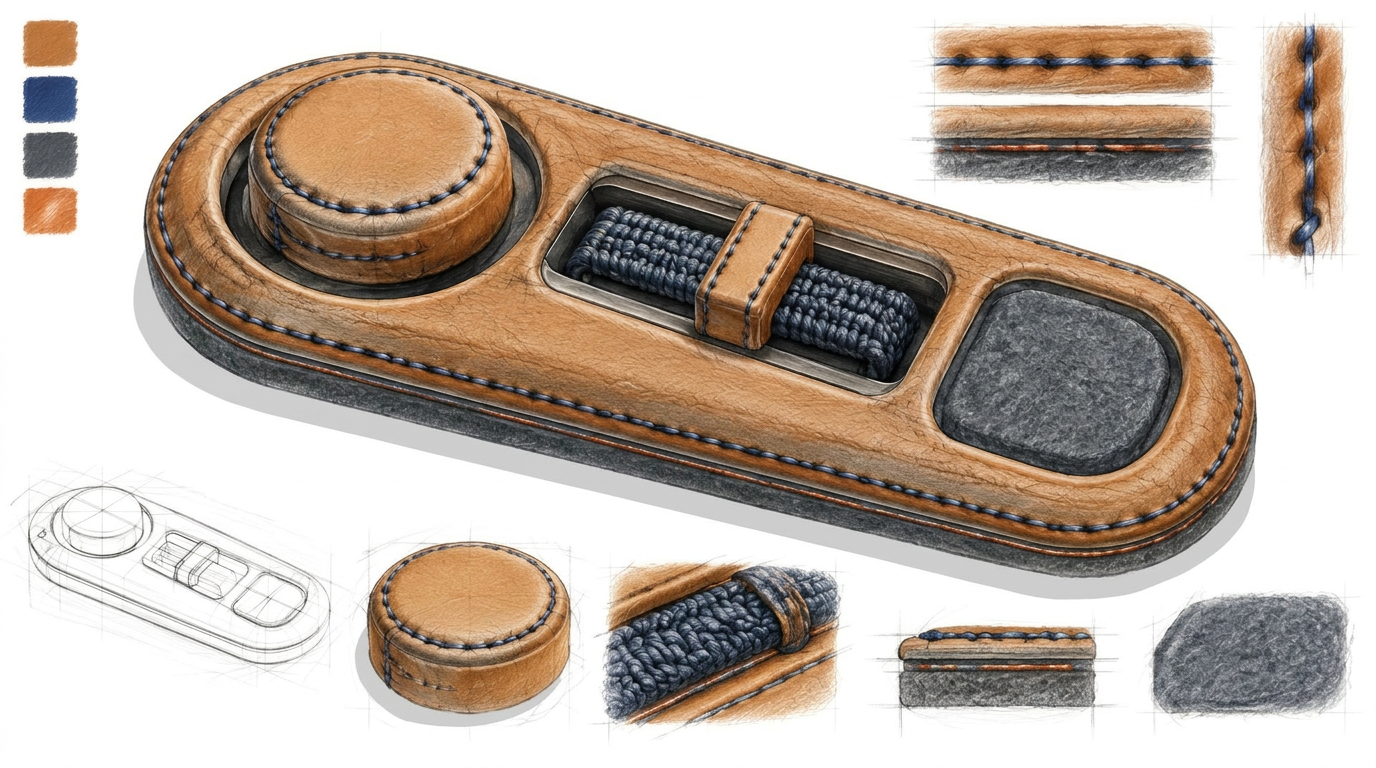
Color study of the control cluster: stitched dial, woven slider, recessed pad, with construction views alongside.
Overview
The cabin does not need another glowing rectangle
A flat display can present many controls, but its surface often feels identical from one function to the next. Physical controls support another sequence: the hand can locate a boundary, identify a target, perform an action, and feel confirmation.
Automotive haptics research separates those moments because finding a control and confirming input are different perceptual tasks (1). This study asks:
Can a secondary vehicle control be integrated into leather and textile trim so its location, gesture, and response are understandable through touch?
The project focuses on a stationary seating buck or passenger-side context. It is a material-interface investigation, not a road-ready control or replacement for safety-critical hardware.
Process
Wireframe, value study, color study
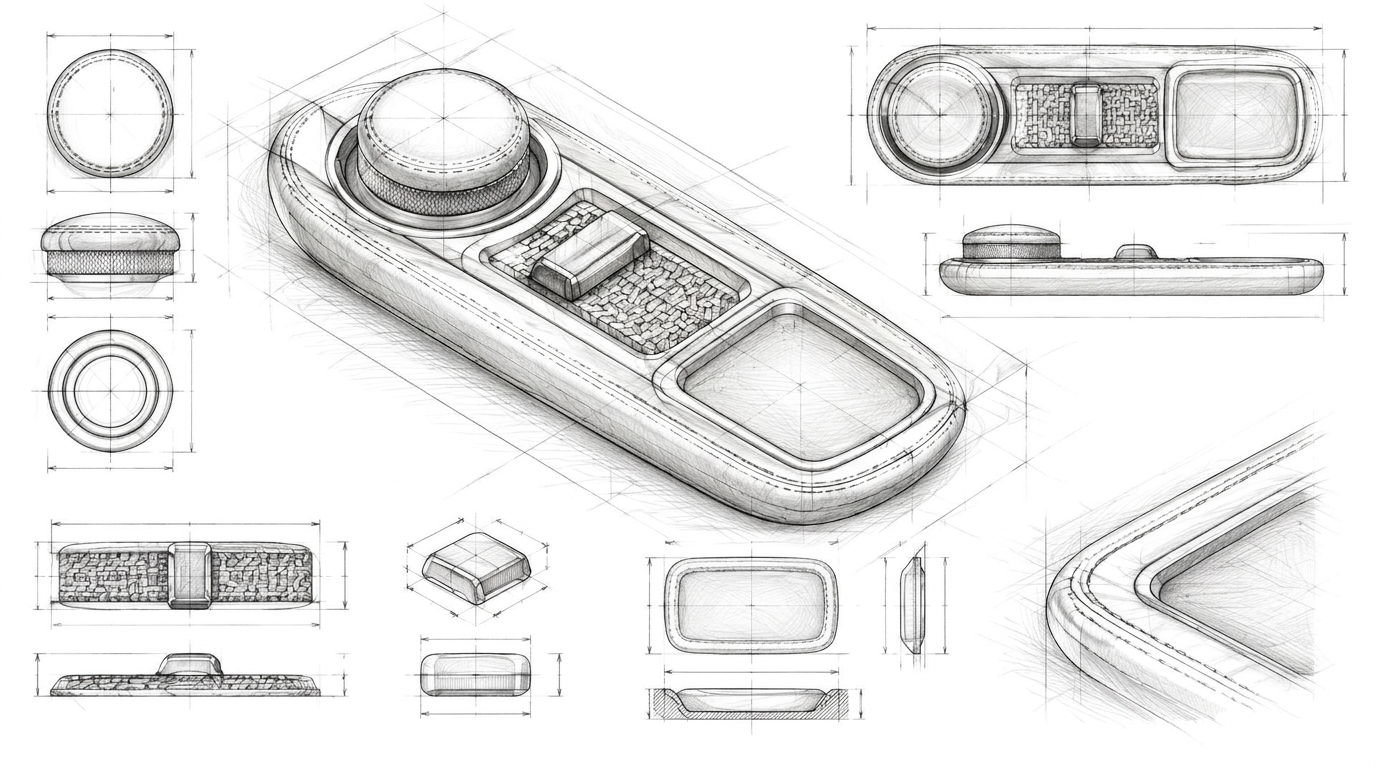
The control cluster develops in three passes. A wireframe fixes the geometry and the relationship among the dial, the slider, and the pad. A tonal value study tests relief — where the hand should find height and where the surface should stay quiet. The color pass then assigns materials to that structure.
Precedent & Scenario
Three noncritical media functions
Conductive embroidery has been used to create fabric widgets such as rockers, menus, zipper controls, proximity controls, and multitouch surfaces (2). FabriCar explored e-textile sensing across fabric and leather for in-car media interaction (3). This study narrows that design space into one restrained, materially integrated control.
The demonstrator supports three functions on a leather-covered door-card section, where a passenger's hand naturally rests, with no screen or hard bezel:
- Press the center to play or pause.
- Trace forward to skip.
- Trace backward to return.
A shallow embroidered boundary, raised center node, and two stitch terminations communicate its presence and direction.
Interaction Model
Discover, act, confirm
A quiet control needs three distinct moments, and this study assigns each to a different material property rather than expecting one texture to do everything.
Discover
A stitched capsule boundary, asymmetric ends, localized cord relief beneath the leather
Act
Embroidered channel for tracing, padded knot beneath center for a distinct press target
Confirm
Short localized vibration, optional reflected light, appears only after input
Discoverability
The outer boundary is a 70 × 38 mm stitched capsule. The forward end terminates in three tightening stitches, the backward end in one broad bar tack, giving direction without printed arrows. A narrow knotted cord sits beneath the leather perimeter, behaving like localized piping that creates enough relief to locate the control while keeping the exposed surface quiet.
Gesture
A central embroidered channel defines the tracing path, with conductive thread following beneath the visible top stitch. A padded knot beneath the center creates a distinct press target, so the continuous directional gestures and the discrete center action have different geometries.
Confirmation
A short localized vibration confirms a successful press or trace. Soft reflected light can provide secondary feedback in the door pocket. The boundary itself remains static — confirmation appears only after input, so the search cue and the response cue stay physically distinguishable.
Material Architecture
Nine layers, visible surface to carrier
Embroidery defines a controlled path and routes conductive thread. Knotting creates volume, resistance, and a soft target. Leather unifies the visual surface. Electronics sense and confirm the action. The interface is built through the operations that construct the trim — cutting, stitching, tensioning, backing, and assembly — not printed onto finished trim afterward.
Framework
Sensing zones and guard space
The center, forward, and backward zones need guard space between them so an accidental touch at the boundary doesn't register as input, and each end needs its own electrical exit for routing to the controller.
Prototype Progression
From appearance to context
01 · Surface study
Visible embroidery, no relief or sensing. Establishes size, proportion, seam language under grazing light.
02 · Tactile buck
Concealed knotted perimeter and padded center. Tests whether the area can be found and the ends distinguished.
03 · Sensing layer
Separate center, forward, backward zones. Electronics exposed on the reverse for legibility.
04 · Door-card context
300 × 450 mm panel with armrest edge, seam, pocket. Tests lateral approach without direct vision.
Validation Protocol
Discovery, interpretation, operation
Discovery: locate the active area with vision and then without it. Record first contact, search path, and whether the perimeter is mistaken for ordinary trim.
Interpretation: before functions are explained, describe what actions the surface appears to support.
Operation: after orientation, perform play/pause, next, and previous. Record incorrect zones, reversed directions, repeated inputs, and whether confirmation is noticed.
Research on eyes-free textile controls indicates that size, placement, and orientation affect performance and must be treated as variables rather than assumed constants (4).
Production Boundary
What this demonstrator does not establish
The demonstrator establishes interaction architecture, not automotive readiness. Production would require false-activation analysis; glove, moisture, dust, and cleaning tests; abrasion, heat, UV, chemical, and aging tests; electromagnetic compatibility; airbag and crash-zone review; service planning; and driving-simulator and on-road studies.
The study does not claim the interface is safer than a touchscreen. It establishes a defensible hypothesis: tactile structure may support lower-visual-attention interaction and warrants controlled evaluation.
Material demonstrator (this study)
- Discover / act / confirm architecture
- Nine-layer material stack
- Stationary seating buck context
- Discovery, interpretation, operation testing
Production qualification (not yet started)
- False-activation analysis
- Environmental and durability testing
- EMC and airbag / crash-zone review
- Driving-simulator and on-road studies
Synthesis
Design synthesis
A quiet control requires three distinct moments: a stable boundary that persists before and after use, a directional or compressible feature that communicates the gesture, and a temporary response that cannot be mistaken for the search cue. Assigning each responsibility to a different material property is clearer than asking one texture to perform all three.
Bespoke-interior direction
This architecture suggests a cabin where functionality is constructed into trim rather than applied afterward. A client-specific stitch geometry could identify a passenger control. A concealed knot could create a tactile signature unique to one commission. Conductive paths could follow an embroidered motif without making the cabin look electronic.
Conceptual direction only, not manufactured or client-commissioned work.
Status & Next Steps
What this study establishes
- A layered architecture for leather, embroidery, knotting, sensing, and feedback.
- A discover–act–confirm model for soft controls.
- A progression from appearance to tactility, sensing, and context.
- A clear boundary between material demonstrator and automotive product.
- A bridge from hand craft to e-textile interaction design.
The vocabulary from Study 02 (pull, press, twist, trace, slide) informed this control's shape directly. Next, Study 04, Tension as Feedback, asks whether cord tension alone can communicate system state.
Source Notes
References
- 1Rümelin, S. et al., "A Theoretical Framework of Haptic Processing in Automotive User Interfaces", PMC.
- 2Textile Interface Swatchbook, ISWC proceedings, on conductive embroidery widgets.
- 3FabriCar, ACM DL, e-textile sensing across fabric and leather for in-car media interaction. Findings belong to that study and are not transferred here.
- 4"Towards Textile User Interface Design Guidelines for Eyes-free Use", RWTH Aachen.