Craft & Material Research · Study 05In Progress
Data in Fiber
Can an engine's architecture — twelve cylinders, paired crankpins, a sixty-degree bank, a firing order — be knotted into a panel so the structure itself is the spec sheet?
September 2026 · Independent Material Research · Methods: engine-architecture encoding, rule-based structural mapping, comparative fabrication · Materials: warp cord, embroidery thread, leather or felt, beads, angle gauge, engine specification sheet

Weave lines converging in V-shaped ridges — the kind of structural crossings the engine-to-fiber grammar builds.
Overview
An engine is already a document
A V12's architecture is a set of numbers someone decided: twelve cylinders, two banks of six, a sixty-degree angle between them, one crankshaft, a published firing order. Most of that architecture is invisible behind the block. This study treats it as data worth holding.
This study asks:
Can an engine's architecture — cylinder count, crankpin pairing, bank angle, and firing order — be encoded in the structure of a knotted panel, so the panel can be read back against the engine's specification sheet?
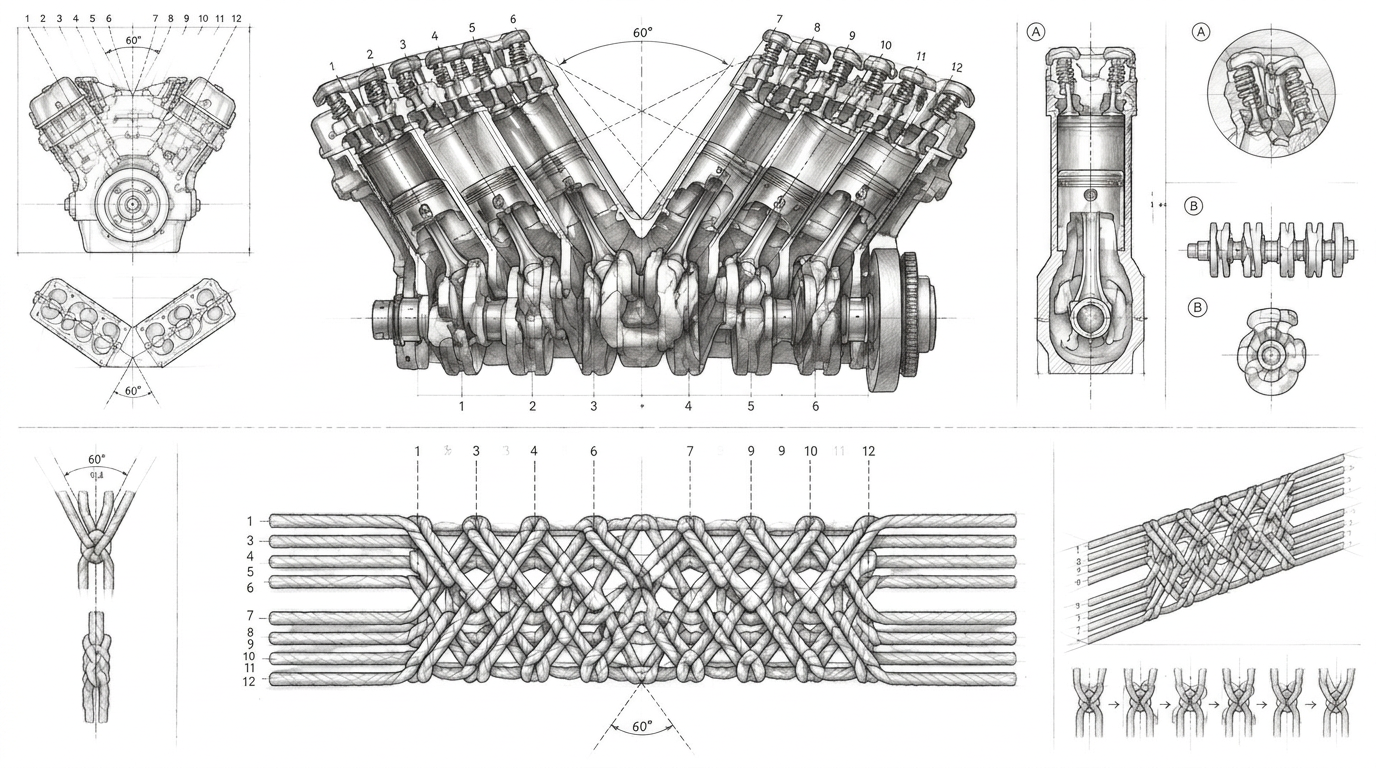
The encoding is structural, not decorative. The fabric does not picture an engine; it is built the way the engine is built. Cylinder count sets the number of cords. Crankpin pairing decides where cords cross. Bank angle sets the crossing angle. Firing order decides the sequence in which the hands travel. Nothing on the panel is placed by eye.
Precedent
Structure as identity
Ferrari's Tailor Made 12Cilindri created for South Korea is the closest precedent (1). Textile artist Dahye Jeong's weaving language informed a three-dimensional fabric, and a hand-woven Mongolian-horsehair artwork was integrated into the dashboard. The commission wove vehicle identity into craft — but the identity lived in material choice and atmosphere, not in the engine's measured architecture.
This study goes one level down. Rather than an engine's character, it encodes an engine's geometry: the facts printed on the specification sheet. The intent follows the data physicalization tradition, where a dataset determines a physical form rather than decorating it (2).
Source Data
The spec sheet is the recording
Where Study 01 recorded safety incidents and earlier mapping work might have started from a signal log, this study starts from a document: one engine's published specification. The reference engine is a 6.5-liter naturally aspirated V12 in a 60-degree configuration, eight cylinders per bank pair sharing one crankshaft, with a manufacturer-published firing order beginning 1-12-5-8-3-10-6-7-2-11-4-9 and a redline near 8,000 rpm.
Provenance is documented the way an instrument recording would be: engine family, model year, displacement, bank angle, firing order, redline, and the publication the numbers come from. The instruction sheet that carries this provenance travels with the finished panel.
Four Encoded Dimensions
What maps to what
Cylinders become warps
Twelve warp cords run the length of the panel, one per cylinder, numbered in engine order along the left edge. The loom is the cylinder bank. A V6 panel would carry six warps; a flat-six, six warps crossing differently.
Crankpin pairing becomes V intersections
In a V12, cylinder n and cylinder n+6 share one crankpin — twelve cylinders ride on six pins. Each pair's warps therefore cross once, forming a V-shaped interlocking knot at that shared pin. The panel contains exactly six intersections, not twelve: the knot count is the crankpin count. This is the detail the fabric knows that a photograph of an engine does not.
Bank angle becomes crossing angle
The sixty-degree angle between banks becomes the angle at which the two cord groups meet, set with a gauge at every intersection. The V in the fabric is the V in the block, measured rather than suggested.
Firing order becomes working sequence
The knots are not tied left to right. The hands travel the panel in the engine's published firing order — cylinder 1 first, then 12, then 5 — skipping across the layout exactly as combustion does. The finished piece looks symmetric, but the order of its making is the firing order, recorded in the instruction sheet.
A last, smaller encoding: redline revolutions become twist density in the finishing cord, and the even firing interval becomes equal pitch between intersections. Every property in the panel is either measured from the engine or explicitly left to the maker.
Mapping Grammar
Applied by rule, not by eye
| Engine property | Textile structure | Purpose |
|---|---|---|
| Cylinder count (12) | Twelve warp cords | The loom is the bank |
| Crankpin pairing (n + n+6) | V-shaped knot intersection | Two cylinders, one knot |
| Intersection count (6) | Six crossings, no more | Knots equal crankpins |
| Bank angle (60°) | Crossing angle at each knot | Set by gauge, not by eye |
| Firing order | Sequence of knotting | Hands travel as combustion does |
| Firing interval (even) | Equal pitch between intersections | Even-fire rhythm made tactile |
| Redline (≈8,000 rpm) | Twist density in finishing cord | Revolutions become twist |
| Displacement (6.5 L) | Panel area | One scale constant, documented |
The grammar is applied by rule, never adjusted wherever the composition looks empty. Otherwise the result becomes an illustration inspired by engines rather than a data-informed translation.
Data Reduction
Less information, honestly handled
A specification sheet is already a reduction — that is its advantage. There is no waveform to smooth and no spectrum to bin. The design work is deciding which properties structure the cloth and which stay on paper. The system uses four structural encodings (count, pairing, angle, sequence) and three surface encodings (pitch, twist density, panel area).
Everything else in the engine — valve timing, compression ratio, torque curve — is deliberately excluded. A panel that tried to carry all of it would say nothing legibly. The instruction sheet lists what was left out as carefully as what was kept in.
Three Material Interpretations
One source, three outputs
Knot field
A macramé panel of twelve warp cords on a rigid header. The two banks' cord groups run in opposing diagonals and interlock in six V-shaped knots — one per crankpin — each opening held at sixty degrees. It is the most sculptural reading: the V structure is visible from across a room and traceable with a fingertip up close.
Embroidered score
A leather or felt panel where twelve stitched lines replace the warps. Crossings are marked with stitched V motifs in firing order, each motif numbered by position. It is flatter and upholstery-compatible, and suits trim where relief must stay subtle.
Hybrid relief
An embroidered firing-order path sits above a concealed knotted substructure whose crossings carry the V geometry. Stitching provides visual precision while hidden cord provides depth. This version most directly expresses measured architecture guiding hand-built form.
All three interpretations share the same warps, crossings, and sequence. Vertical guides let a reader compare the identical crankpin event across techniques.
Determined by engine
- Cylinder count
- Crankpin pairings
- Bank angle
- Firing order
- Redline
Determined by designer
- Cord and thread selection
- Knot family per crossing
- Panel size and scale
- Marker construction
- Finish and mounting
Process
Architecture study, material study, application
The grammar develops in three passes. An architecture study draws the engine's cylinder layout — banks, crankpins, firing sequence — and connects each measured fact by construction line to the crossing it becomes. A material study tests the crossings themselves: cord diameter, the sixty-degree gauge, knot families, and a stitched firing-order sample. The application pass carries the grammar into the cabin, where the V crossings become relief across trim.
Validation Protocol
Reading it back
The test is not whether the panel is beautiful; it is whether the engine can be recovered from the fabric. First, a counter-reading: a participant who knows engines receives the panel and the instruction sheet, and is asked to state cylinder count, bank angle, and firing order from the structure alone. Second, a trace test: participants follow the firing order across the panel's intersections from the sequence card, and their path and errors are recorded.
A second comparison translates two different engines — the V12 and a flat-six — through the same grammar. If the two panels feel identical, the mapping is too coarse. If the crossings feel arbitrary, it is too sensitive. The structural distinctions that matter are count, crossing geometry, and sequence, and all three must be distinguishable by hand.
From Representation to Interaction
A later extension
A later version could place a conductive contact at each intersection so the panel logs which crankpin a visitor's hand visits, in what order — the fabric recording touch the way the instruction sheet records the engine. That extension remains secondary. The first responsibility is a coherent architecture-to-material grammar. Electronics should not compensate for unclear physicalization.
Bespoke-Interior Direction
Traceable commissions
Possible commissions include an owner's engine serialized into a seatback panel, a race engine's architecture compressed into console trim, a motorcycle's twin encoded as a pair of crossing cords, or a delivery date and chassis number knotted into a commission book. The value is traceability: a particular engine's numbers pass through a documented grammar and are fabricated for one object.
What This Study Establishes
Outputs
- A repeatable grammar for encoding engine architecture in fiber.
- A distinction between measured structure, designed reduction, and craft interpretation.
- Three comparable outputs from one specification sheet.
- A counter-reading test: recovering the engine from the fabric.
- A bridge connecting data physicalization, macramé, and automotive identity.
Source Notes
References
- 1Ferrari Tailor Made 12Cilindri for Korea, Ferrari Magazine.
- 2List of Physical Visualizations, dataphys.org — the running archive of data physicalization work.