Craft & Material Research · Study 02Complete
Perceived Affordances in Knots
Which structural qualities make a knot's intended action discoverable through sight and touch?
March 2026 · Independent Material Research · Methods: material prototyping, interaction decomposition, comparative analysis · Materials: cotton cord, waxed cord, leather, wool felt, wood, thread

Twisted strands crossing and knotting — the structural vocabulary this study treats as an interface language.
Interactive · Tap a point
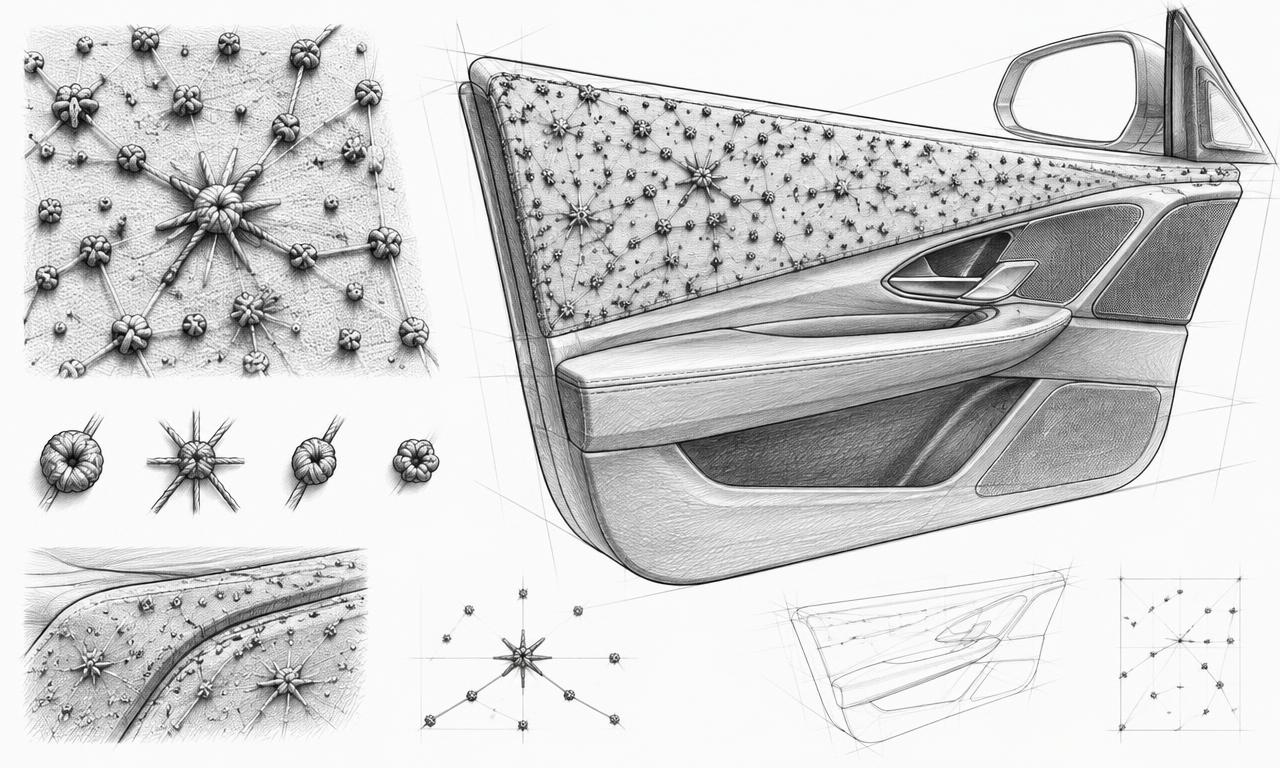
A starlight door card, read point by point
Every knot, line and stitch on this panel records something. Select a glowing point to see what it is — and what it means.
01 / 06The night sky
What you see
About 140 single knots scattered across the upper panel, each one tied and trimmed flush so only a bead of cord catches the light.
What it means
The sky exactly as it hung over the hospital the night the owner was born — every knot is a real star brighter than magnitude 4.5, placed by its true position. The owner has been carrying this sky around their whole life without seeing it; now it rides with them.
Overview
A knot is already an instruction
A loop invites a finger. A free tail suggests pulling. A raised ridge asks to be traced. A compact knot can feel pressable even when it contains no switch.
Digital interfaces communicate action through signifiers: a button appears pressable, a handle appears draggable, and a text field appears ready to receive input. Material interfaces communicate through scale, relief, resistance, texture, anchoring, and movement. The hand often begins forming an expectation before an instruction appears.
This study asks:
Which structural qualities make a knot's intended action discoverable through sight and touch?
The distinction between physical and perceived possibility is important. A cord can permit pulling while its mounting makes that action appear accidental. Conversely, a raised knot can look interactive while being too rigid to move. Don Norman describes this distinction through real and perceived affordances: the actions an object permits are not necessarily the actions a person believes it permits (1) (Norman, "Affordance, Conventions and Design").
The objective is not a collection of decorative knot samples. It is a vocabulary of textile interface primitives: pull, press, twist, trace, and slide.
Research Proposition
Four propositions
- Relief establishes target location. A raised structure should be easier to find than a flat change in color.
- Freedom of movement suggests gesture. A free loop or tail should communicate pulling more strongly than a fully anchored form.
- Directional construction suggests direction. Ridges, spirals, and channels should guide movement along their dominant axis.
- Constraint makes action legible. A physical stop or return path distinguishes intentional interaction from loose material.
These propositions determine the sample construction and analysis. They are not claims about universal intuition. Meaning can vary with dexterity, prior experience, context, and culture.
The Swatch Library
Twelve swatches, one variable
The library contains twelve 100 × 140 mm swatches. Cord color, diameter, backing size, and active-area placement remain as consistent as possible so that structure — not styling — becomes the primary variable.
| Family | Samples | Variable | Intended action |
|---|---|---|---|
| Loop | 3 | Opening size and stiffness | Hook or pull |
| Tail | 2 | Length and termination | Pinch and pull |
| Ridge | 2 | Height and orientation | Trace |
| Spiral | 2 | Torsion and grip length | Twist |
| Node | 2 | Compression and rebound | Press or squeeze |
| Channel | 1 | Bounded linear travel | Slide |
Each swatch is analyzed through four parts:
- Target: what the hand finds.
- Action: what movement the material appears to invite.
- Constraint: what bounds or directs the movement.
- Feedback: what changes during or after the action.
A visually compelling knot is not automatically an interface. It becomes one when the intended action is discoverable, bounded, and followed by a perceptible response. This emphasis follows the principles of Material Driven Design (2) (Karana et al., 2015).
Action Vocabulary
Five primitives
Pull
Loops communicate entry. A free tail communicates direction but needs deliberate termination.
Press
Raised nodes communicate target and compression. Passive rebound can confirm completion.
Twist
Spirals communicate grip and rotation. A hidden stop keeps torsion from feeling like deformation.
Trace
Ridges give the fingertip a start, lateral guidance, and a distinct termination.
Slide
Parallel boundaries communicate guided travel. Fiber tension replaces a rigid track.
Process
Construction study, material study, application
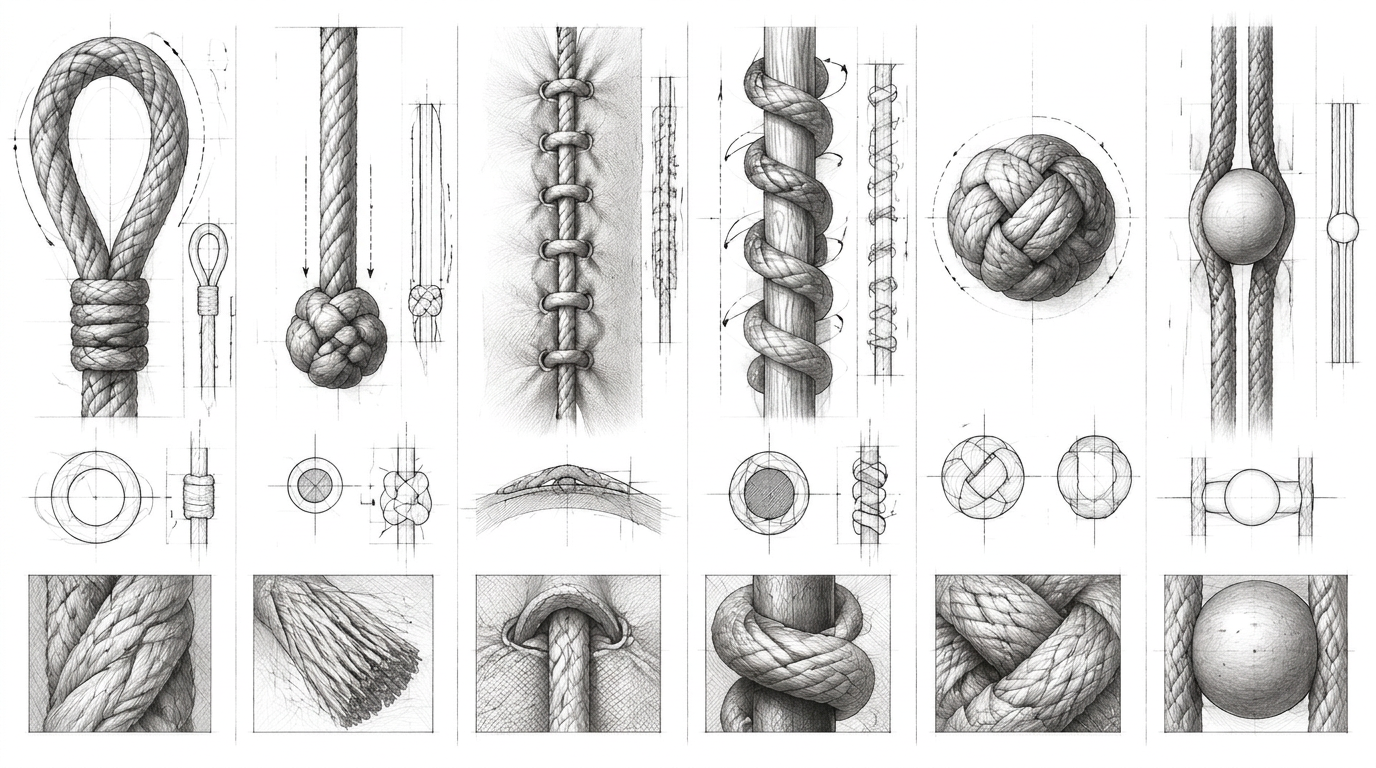
The vocabulary develops in three passes. A black-and-white construction study fixes each primitive's geometry — loop, tail, ridge, spiral, node, and channel — and where relief should rise or stay quiet. A material study then works from the real samples: cord diameter, leather temper, and felt body, drawn at scale so the hand's expectations can be checked before a swatch is built. The application pass places the primitives in the cabin, where a knotted pull, a stitched channel, and a raised node become quiet secondary controls.
Structures
What each family tests
Pull structures
The pull family compares three forms: a finger loop, a broad square-knot tab, and a free tail ending in a stopper knot. The loop offers the clearest point of entry; its opening frames the finger and distributes load across a curved surface. The broad tab creates a pinch surface that can lie flat when inactive, making it compatible with leather goods. The free tail communicates direction most strongly but carries the greatest risk of appearing unfinished — a deliberate termination, return position, and travel limit are necessary to signal that movement belongs to the object's function.
Press structures
The press family compares a compact button knot over felt with a flatter padded square knot. Neither sample requires electronics: compression and rebound provide passive feedback. The question is whether the knot geometry communicates "press here" and whether the hand can recognize completion without visual confirmation.
Twist structures
The twist family uses alternating half-hitch spirals around a semi-rigid core. A short, dense version behaves like a soft knob; a longer version like a sleeve that can be rolled between the fingers. The core prevents collapse, while a hidden stop limits rotation — without that constraint, twisting can feel like deforming the object rather than operating it.
Trace and slide structures
The trace family separates movement into entry, travel, and termination: a raised ridge gives the fingertip a starting point, maintains lateral guidance, and ends in a distinct cross-stitch. The slide structure suspends a bead or compact knot between parallel cords, borrowing the mental model of a slider while replacing a rigid track with fiber tension. The aim is not numerical precision, but whether beginning, middle, and end can feel different.
Validation Framework
Observed, not assumed
The swatches are evaluated individually and in randomized order. The first stage is open interpretation: "What do you think you can do with this?" The second records the first action attempted. The third asks which cue suggested that action. A subset is repeated without sight to separate visual signification from tactile discoverability.
Useful observations include first gesture, secondary gesture, hesitation, confidence, location errors, and descriptive language. Results are reported as counts with the participant total visible, not inflated percentages from a small sample. Research on haptic icons demonstrates why recognizability must be observed rather than inferred: textile shape, height profile, and surface condition can alter eyes-free recognition (3) (ACM, "What's That Shape?").
Material Grammar
From samples to selection rules
- Loops communicate entry and pull.
- Free tails communicate direction but need deliberate termination.
- Raised nodes communicate target and compression.
- Spirals communicate grip and rotation.
- Parallel boundaries communicate guided travel.
- Density changes can mark transitions or endpoints.
- Passive rebound can confirm completion without electronics.
The outcome is not one "best" knot. It is a method for selecting structure according to action.
Automotive Direction
Quiet secondary controls
In a vehicle interior, these primitives would function best as quiet secondary controls rather than replacements for safety-critical hardware. A short knotted pull could open storage. A stitched channel could guide a hand toward a seat adjustment. A compact node could confirm an ambient-light selection. A ridge could help a passenger locate a control without searching a glossy panel.
The opportunity is not to cover a cabin in macramé. It is to use fiber with the precision usually associated with machining: one material gesture, one action, and one clear response.
What This Study Establishes
Outputs
- A repeatable way to analyze knots as interaction structures.
- A swatch system separating action cues from decoration.
- A framework connecting target, action, constraint, and feedback.
- A method for comparing visual and tactile discoverability.
- A reusable vocabulary for leather goods, furniture, vehicle trim, and spatial interfaces.
The vocabulary of pull, press, twist, trace, and slide informs Study 03, Quiet Controls, directly: a center node borrows the press logic, a tracing channel borrows the ridge family's guided direction.
Source Notes
References
- 1Don Norman, "Affordance, Conventions and Design", jnd.org.
- 2Elvin Karana et al., 2015, "Material Driven Design", International Journal of Design.
- 3"What's That Shape?", ACM CHI, on eyes-free recognition of textile haptic icons.