The Challenge
Porsche's online configurator offers over 700 options per vehicle model. While enthusiasts appreciate this depth, 64% of users abandoned their configurations before completion. The paradox of choice was costing conversions.
I was tasked with designing a system that preserved Porsche's commitment to personalization while reducing decision fatigue for mainstream buyers.
"How might we guide customers toward confident decisions without compromising the depth that defines the Porsche ownership experience?"
The Paradox of Choice
Psychologist Barry Schwartz's research shows that more options often lead to worse decisions and lower satisfaction. Porsche's configurator embodied this paradox: 700+ options per vehicle created decision paralysis for mainstream buyers, while the interface was optimized for enthusiasts who already knew exactly what they wanted.
The result? Nearly two-thirds of users abandoned their configurations before completion, representing significant lost revenue and missed opportunities to convert interested buyers into owners.
The Scale of the Problem
Where Users Drop Off
Session analysis revealed three critical friction points in the configuration journey:
Understanding User Friction
My approach centered on understanding where users struggled and why. I employed a mixed-methods research strategy combining competitive benchmarking, qualitative interviews, and behavioral analytics to build a comprehensive picture of user friction.
Competitive Analysis
Benchmarked BMW, Mercedes, and Tesla configurators to identify industry patterns, gaps, and opportunities for differentiation.
User Interviews
Semi-structured interviews across three segments: first-time buyers, returning customers, and Porsche enthusiasts.
Session Analysis
Analyzed Hotjar session recordings to identify drop-off points, rage clicks, and confusion patterns in real user behavior.
Key Insights
Research synthesis revealed three core friction points that mapped directly to the drop-off data:
Option Overload
"I spent 20 minutes just on wheels. There were so many options and I had no idea which ones actually looked good on this color." — First-time buyer participant
Confidence Gap
"PASM? PDCC? I don't know what any of these acronyms mean. I just want a car that handles well." — Returning customer participant
Missing Context
"I picked options I liked individually, but when I saw the final car it looked like a mess. Nothing went together." — Enthusiast participant
Design Recommendations: Curated Confidence
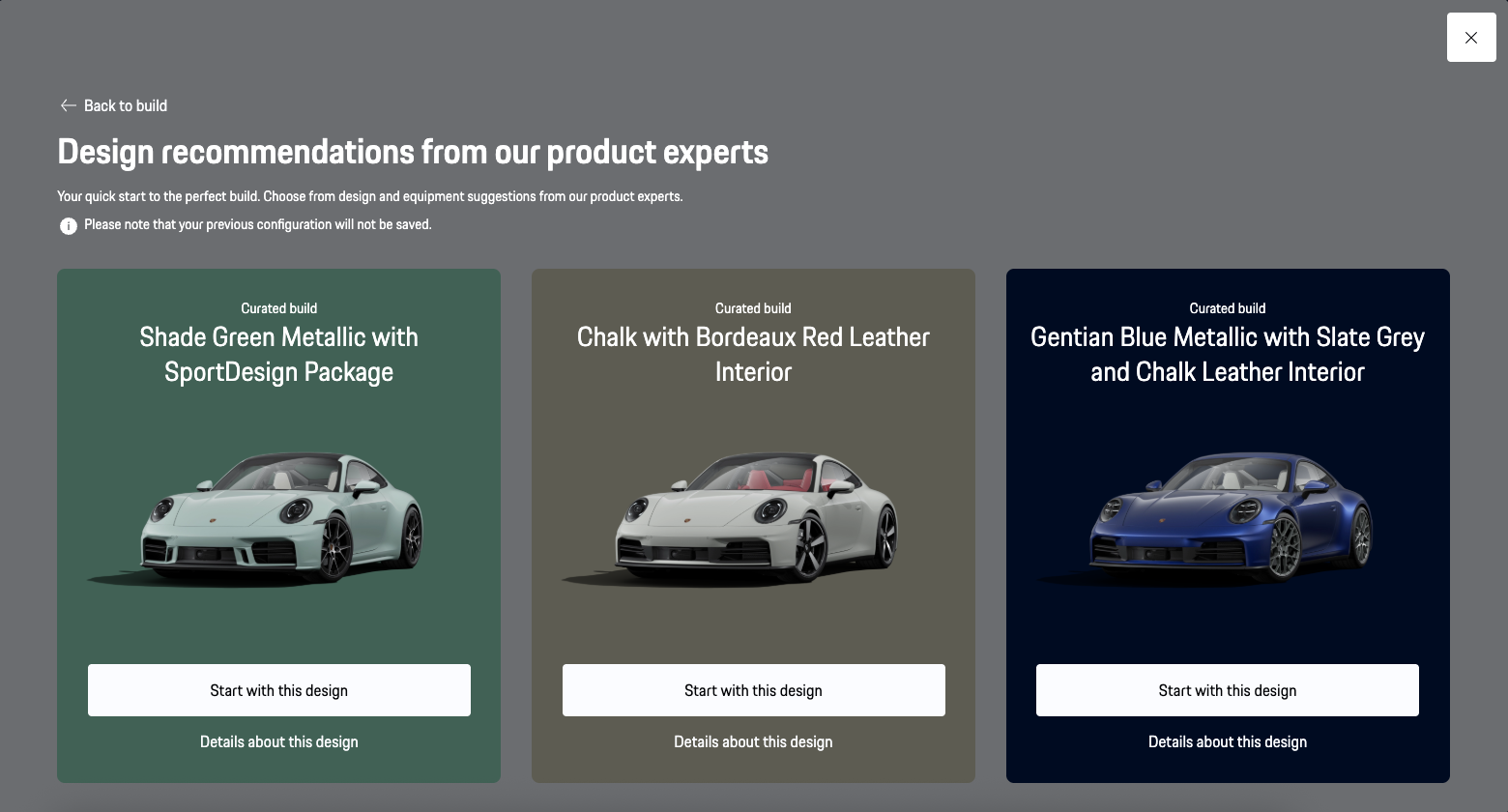
Rather than reducing options, I designed a progressive disclosure system that surfaces expert-curated recommendations while keeping the full catalog accessible for enthusiasts. The key insight: simplicity doesn't mean fewer choices, it means better defaults.
Three Design Principles
The solution was grounded in three core principles that directly addressed the research findings:
Progressive Disclosure
Show curated recommendations first, individual options on demand. This reduces cognitive load while preserving choice. Users who want full control can always access every option, but they're not overwhelmed from the start.
Expert Authority
Frame recommendations as "Porsche Designer Picks" rather than algorithmic suggestions. In luxury contexts, users want human curation, not algorithms. The credibility of Porsche's design team becomes a trust signal.
Visual Coherence
Real-time preview shows how options look together before committing. This builds confidence and reduces decision paralysis by letting users see the complete picture, not just individual parts.
User Flow: Progressive Disclosure in Action
See Curated Packages
3 designer-curated options shown first
Preview in Context
See how package looks on your vehicle
Accept or Customize
Apply package or drill into details
Complete with Confidence
Finish configuration in less time
Business Impact
The redesigned configurator was A/B tested against the existing flow with a rigorous methodology designed to isolate the impact of design recommendations.
A/B Testing Methodology
Measured Impact
Executive Buy-in Achieved
Based on A/B test results, the solution received approval for global rollout and integration into the dealer consultation flow across all Porsche markets.
What I Learned
-
Constraints Enable Focus
Working within Porsche's existing design system forced creative solutions that integrated seamlessly rather than requiring new patterns.
-
Luxury Requires Trust
In premium contexts, users want expert guidance, not algorithmic suggestions. Framing recommendations as human-curated was critical to adoption.
-
Simplicity Preserves Choice
The goal wasn't fewer options, but better defaults. Enthusiasts still accessed every option; mainstream buyers found confidence faster.